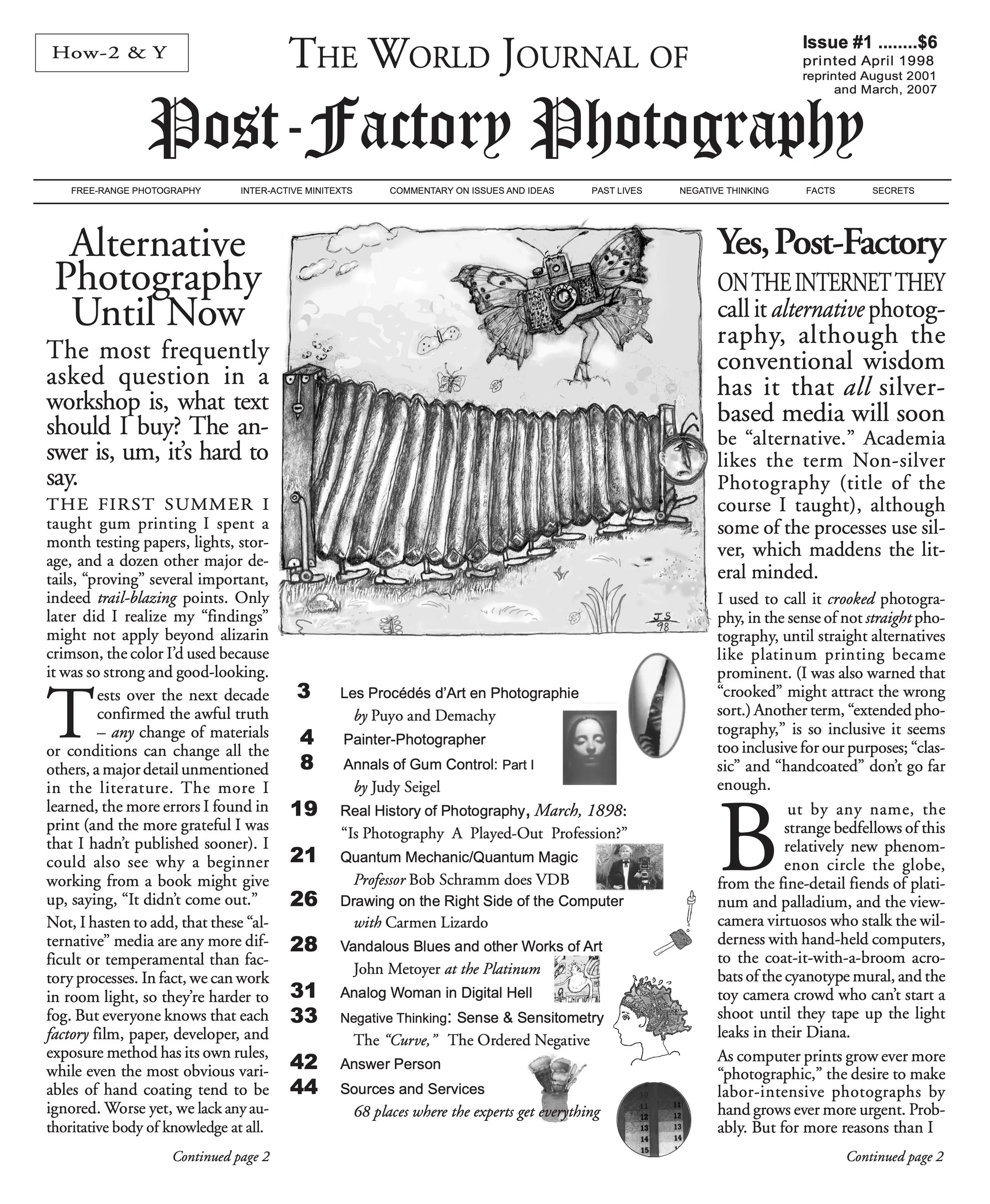
Between 1998 and 2004, Judy Seigel’s “World Journal of Post-Factory Photography” emerged as the indispensable bible for alternative photography's revival. The first stand-alone alt-photo publication in the U.S., the journal helped fuel rediscovery of the expressive possibilities of 19th-century processes worldwide, offering both practical guidance and philosophical depth.
Between 1998 and 2004, Judy Seigel’s “World Journal of Post-Factory Photography” emerged as the indispensable bible for alternative photography's revival.
The first stand-alone alt-photo publication in the U.S., the journal helped fuel rediscovery of the expressive possibilities of 19th-century processes worldwide, offering both practical guidance and philosophical depth.
Publishing from Greenwich Village, Seigel coined the term "post-factory" to capture photographers embracing labor-intensive handwork as digital reproducibility took over. Subscribers in 33 countries called it a "perfect combination of technicalia and artspeak." For her expertise and innovations, Christopher James dubbed her and the publication "a legend in the elucidation of alternative processes.”
The journal featured never-before-translated historical content, such as early 1900s manifestos by French Pictorialists Puyo and Demachy arguing that only "intervention" makes photography "artistic"—the raison d'être of this new “antiquarian avant-garde.” Articles covered gum bichromate, kallitype, palladium, cyanotype, bromoil, and all manner of toning and printing. Features highlighted forgotten masters like František Drtikol alongside Julia Margaret Cameron and modern innovators like chemist Mike Ware.
The journal featured never-before-translated historical content, such as early 1900s manifestos by French Pictorialists Puyo and Demachy arguing that only "intervention" makes photography "artistic"—the raison d'être of this new “antiquarian avant-garde.” Articles covered gum bichromate, kallitype, palladium, cyanotype, bromoil, and all manner of toning and printing.
Amid profiles, book reviews, and How-To, Seigel's voice crackled throughout, skewering sacred cows and championing underdogs bucking the “purity” dogma of conventional “straight” photography.

Features highlighted forgotten masters like František Drtikol alongside Julia Margaret Cameron and modern innovators like chemist Mike Ware. Amid profiles, book reviews, and How-To, Seigel's voice crackled throughout, skewering sacred cows and championing underdogs bucking the “purity” dogma of conventional “straight” photography.


ISSUES 1 - 4
Issues 1-4 of the World Journal of Post-Factory Photography are now available for the first time as PDFs — converted directly from founder Judy Seigel's original computer files, so crystal clear, not scans. A password file comes with the download to unlock the PDF.


ISSUES 5 - 9
To order physical issues 5-9 still available in print, contact postfactoryjournal@gmail.com. And please say hello to Judy's daughter, Jessica, a journalism professor and culture-science writer. Prices are:
$37.00 for issues #6, #7, #8, #9
$46.00 for issues #5, #6, #7, #8, #9