
PhotoPlace Gallery - Juror’s Statement
I thank all artists for submitting work to Analog—Made By Hand. I’ll provide some insight for how I select images for a show. I go through the entire submission several times with an eye towards technical skill first. Next step is to go through the submissions again and separate images into Yes, No, and Maybe. In the Yes folder I pick “best of the best” at which time I get a sense of the vision of the show. I want the show to give a broad view of artists and alt today. Work is not chosen in a vacuum but in relation to all other entries. After multiple times of visiting all three folders to where I am satisfied with my choices, I create intermediate folders, something like Yes, If There Is Room, Maybe, Favorite Nos, and Probably OK to eliminate.
As for process, nothing beats an exquisite platinum or cyanotype print, but what has recently been growing is the convergence of printmaking and photography, combining multiple processes, pushing process in new ways (e.g. wet cyanotype prints, distressed color or B&W negatives, distressed prints, color prints out of BW paper aka lumen printing), and this indicates to me a desire to return to handmade work but also to push boundaries. The photogram is alive and well both in the BW darkroom and outside with cyanotype and lumens. Gum printing is more exquisitely practiced today due to the advent of easy tricolor separation digital negatives (easy being an operative word) which in itself is ironic since it is so much easier to print digital color. Wet plate collodion has grown in practice, probably for its dark, moody aesthetic. A new kid on the block is a duotone or tricolor cyanotype accomplished by printing multiple layers of cyanotype most likely influenced by Annette Golaz’ Cyanotype Toning book. Combination printing in all forms has arrived.
Concept includes eco-anxiety, political anxiety, humor and irony, abstraction, the banal, self-portraiture, and always beauty, but now beauty tied to more than just pretty women or landscapes but daily tasks like wrinkles in laundry, soft grass and barking dogs, messy flowers squished on sensitized paper.
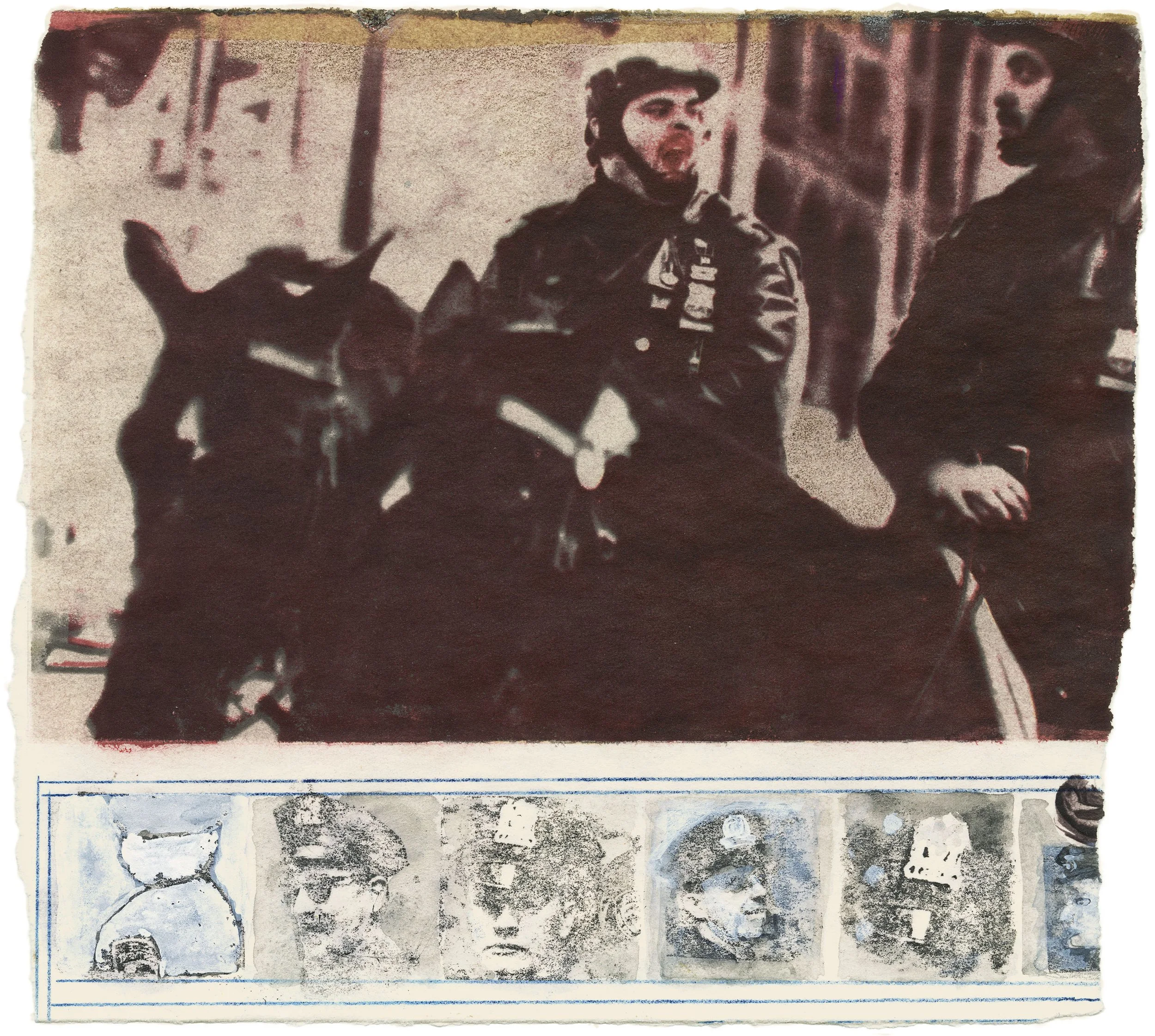
I was asked to select one print for the Juror's Award and that is always hard because I can look at each print chosen and tell you why it is award-worthy. I choose Judy Seigel's "Cop Yawning, Halloween" for the Juror’s Award because of its complex contemporary read, the ruddy lips of the policeman yawning on the horse juxtaposed with the delicate portraiture of the individuals at the bottom.
Also I was asked to choose three honorable mentions. I first selected Barbara Hazen's "White Shirts" which is an exquisite pt/pd print of hanging laundry. Next, I selected Aindreas Scholz's "The Most Beautiful Anthropocene No. 3" which is a complex and beautiful lumen print. Lastly, I selected Thomas Whitworth's "What's the Meaning of This (Boy in Doorway)" for its dissonant contemporary read.
-Christina Z. Anderson
The directors awards goes to Richelle Forsey for their image "There Were Signs". I selected this work for its use of the Mordançage process, which combines darkroom printing with delicate chemical manipulation of the photographic surface. The result is a deeply analog, hands-on approach that transforms the print into a unique, one-of-a-kind object.
-Zach Hoffman, Gallery Director
About the Juror
Christina Z. Anderson’s work focuses on the contemporary vanitas printed in a variety of alternative photographic processes, such as gum and casein bichromate, cyanotype, salted paper, vandyke brown, argyrotype, chrysotype, platinum-palladium, chemigrams, chromo, mordançage, lumen prints, and combinations thereof.
Anderson’s work has shown nationally and internationally in over 130 shows and 90 publications. She has six books in print which have sold in over 40 countries: from newest to oldest, The Experimental Darkroom: Contemporary Uses of Traditional Black & White Photographic Materials, Digital Negatives with QuadToneRIP, Demystifying QTR for Photographers and Printmakers (co-authored with Ron Reeder), Cyanotype, The Blueprint in Contemporary Practice (now in a French edition Cyanotype, L’Art et La Technique), Salted Paper Printing, A Step-by-Step Manual Highlighting Contemporary Artists, Gum Printing, A Step by Step Manual Highlighting Artists and Their Creative Practice, and Gum Printing and Other Amazing Contact Printing Processes. Her seventh book Platinum-Palladium PRINTING A Step-by-Step Manual of the Develop-Out Process will be released Fall 2026.
Anderson is Editor for Focal Press/Routledge’s Contemporary Practices in Alternative Process Photography series and Professor of Photography at Montana State University. To see her work, visit christinaZanderson.com and @christinaZanderson.
